Team story
Origins
Ken Tyrrell built his reputation in junior formulae and recognised Jackie Stewart’s talent early on. In Formula 1 he first ran the Matra-Fords of 1968 and 1969; faced with the French company’s new engine strategy, he chose to retain the Cosworth and secretly commissioned Derek Gardner to design a car of his own. The 001 made its debut in 1970 with almost no warning, built in a simple timber shed at Ockham but fast enough to challenge Lotus and Ferrari immediately.
The Formula 1 journey
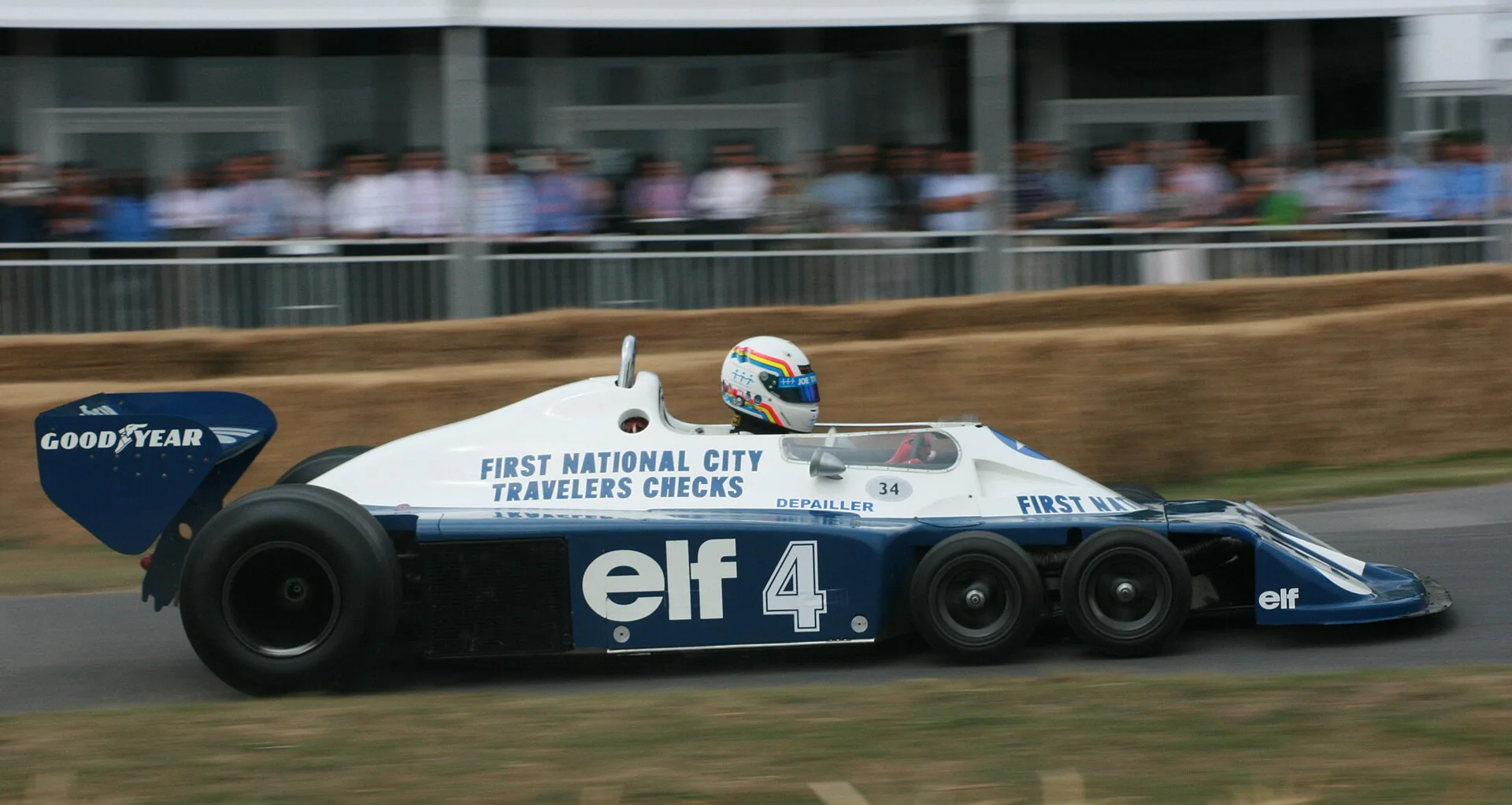
In 1971 Stewart won six races, the Drivers’ title and the team’s only Constructors’ Championship; another Drivers’ title followed in 1973. After the Scot’s retirement and François Cevert’s death, Tyrrell had to rebuild. The six-wheeled P34 won in Sweden in 1976 and became the symbol of its boldness, but rising costs made it increasingly difficult to compete as an independent.
The final victory, at Detroit in 1983 with Michele Alboreto, was also the last for the Cosworth DFV family in Formula 1: the Tyrrell used the DFY development.
Historical timeline
Three chapters in the story of Tyrrell
Three episodes to revisit the people, cars and races that shaped this journey.
First appearance · Canadian Grand Prix
Jackie Stewart · Canadian Grand Prix 1970. The recorded outcome is DNF. This is the first recorded race start, or the first entry if the team never started a race.
Sporting landmark · Spanish Grand Prix
Jackie Stewart · Spanish Grand Prix 1971. The recorded position is P1; this number alone does not show whether the driver completed the race distance. This marks the first win or podium where one exists, otherwise the highest recorded placing for this constructor.
Latest recorded appearance · Japanese Grand Prix
Toranosuke Takagi · Japanese Grand Prix 1998. The recorded outcome is DNF. This is the last race start attributed to this constructor in the archive, not necessarily the end of the organisation behind it.
A distinctive way of racing
The team directly reflected Ken Tyrrell’s character: close observation of drivers, discipline, thrift and personal trust. His relationship with Stewart went beyond the sporting contract and contributed to the campaigns for safer circuits and cars. Technically, Tyrrell alternated between conservatism and boldness: it exploited the Cosworth-Hewland package to the full, but also approved the P34 when it saw a tangible advantage in reducing frontal drag.
As electronics, wind tunnels and industrial budgets expanded, that family-style model gradually lost effectiveness without surrendering its independence.
What remains
Tyrrell represents the transition from the Formula 1 of small racing outfits to a global industry. Ken ran the team with paternal authority, an eye for drivers and a frugality that compensated for modest budgets for many years. When he sold the entry to British American Tobacco, the corporate line continued through BAR, Honda, Brawn and Mercedes.
Thus a team that disappeared in 1998 indirectly lives on in one of the championship’s most successful organisations, while the P34 preserves its most recognisable image.