Team story
Origins
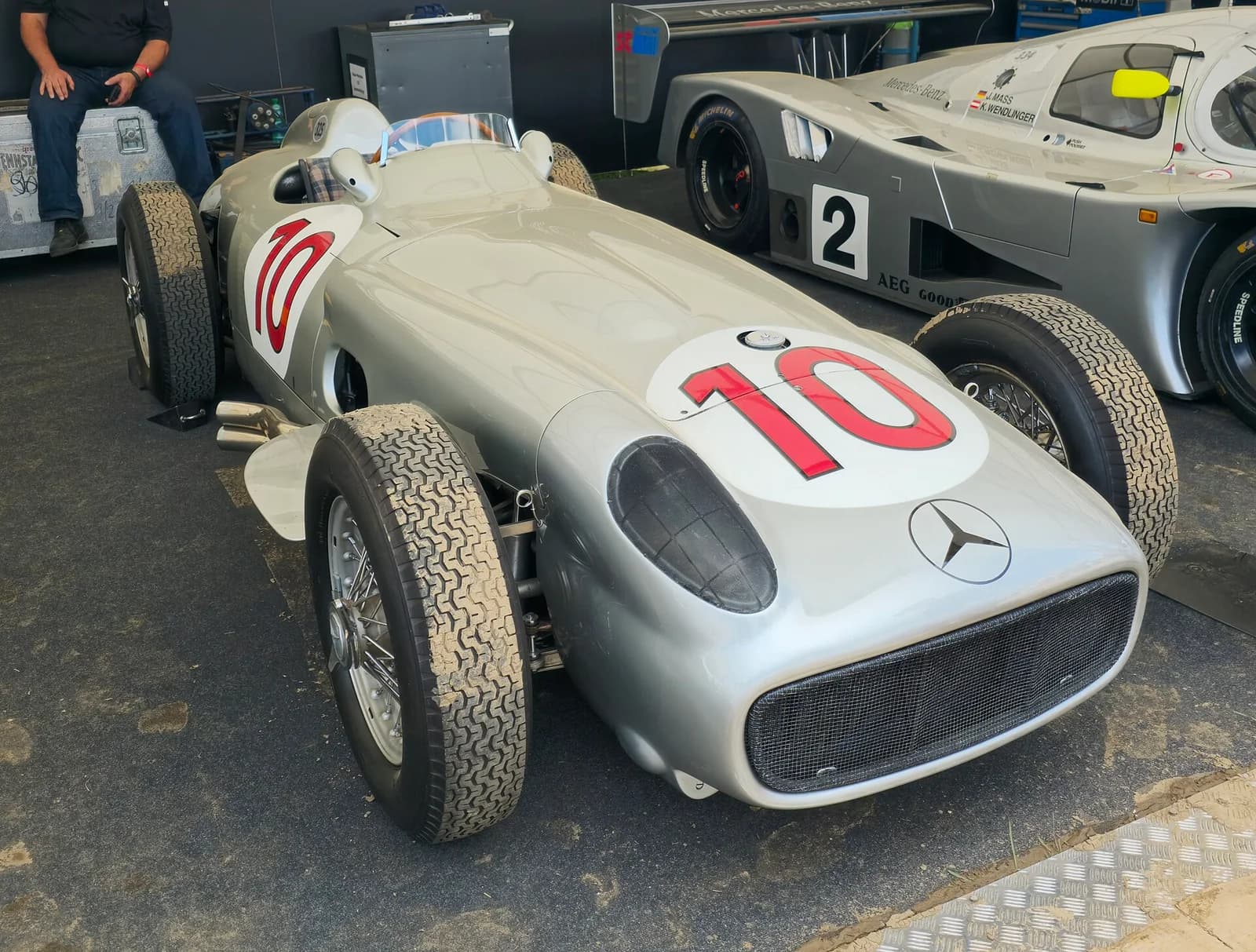
The Silver Arrows belonged to Grand Prix racing even before the World Championship began. Mercedes entered World Championship Formula 1 in 1954 with the W196 and Juan Manuel Fangio, immediately winning the 1954 and 1955 Drivers' titles; the Constructors' Championship did not yet exist. After withdrawing at the end of 1955, the brand gradually returned as an engine supplier, particularly through its connection with McLaren.
The modern works team was created in 2010 through the acquisition of Brawn GP and the Brackley organisation that had already passed through BAR and Honda.
The Formula 1 journey
The years with Schumacher and Rosberg prepared an organisation integrating the Brackley chassis operation and Brixworth power units. When the hybrid regulations arrived in 2014, Mercedes was ready: it won eight consecutive Constructors' Championships through to 2021 and seven Drivers' titles with Lewis Hamilton and Nico Rosberg. This was not simply engine superiority: reliability, simulation, people management and the ability to develop the car through very long seasons made the system led by Toto Wolff extremely difficult to break.
Historical timeline
Three chapters in the story of Mercedes
Three episodes to revisit the people, cars and races that shaped this journey.
First appearance · French Grand Prix
Juan Manuel Fangio · French Grand Prix 1954. The recorded position is P1; this number alone does not show whether the driver completed the race distance. This is the first recorded race start, or the first entry if the team never started a race.
Sporting landmark · French Grand Prix
Juan Manuel Fangio · French Grand Prix 1954. The recorded position is P1; this number alone does not show whether the driver completed the race distance. This marks the first win or podium where one exists, otherwise the highest recorded placing for this constructor.
Latest recorded appearance · Spanish Grand Prix
George Russell · Spanish Grand Prix 2026. The recorded position is P5; this number alone does not show whether the driver completed the race distance. This is the latest start in the archived snapshot, not the end of the team’s activities.
A distinctive way of racing
Two bases help explain modern Mercedes: Brackley for the chassis, Brixworth for the engine. The 2014 regulations rewarded the work done at both, but did not remove the difficulties of a team fielding Hamilton and Rosberg. The pair brought results and, alongside them, a rivalry that also made internal management complicated.
From 2022, the main problem was different: adapting the car to the new ground-effect rules. Comparing those periods is instructive, because the same organisation went from defending an advantage to looking for the reasons why that advantage was no longer there.
What remains
Fangio's W196s and Hamilton's hybrid single-seaters belong to two chapters separated by more than half a century. It is important not to describe them as a single team that remained on track without interruption. The 2010 return came from the acquisition of Brawn GP; the subsequent eight consecutive Constructors' titles gave that organisation a precise place in history.
The seasons beginning in 2022 add a different chapter, in which past results are not enough to solve a new project. For Mercedes too, starting again means finding answers that the previous cars can no longer provide.