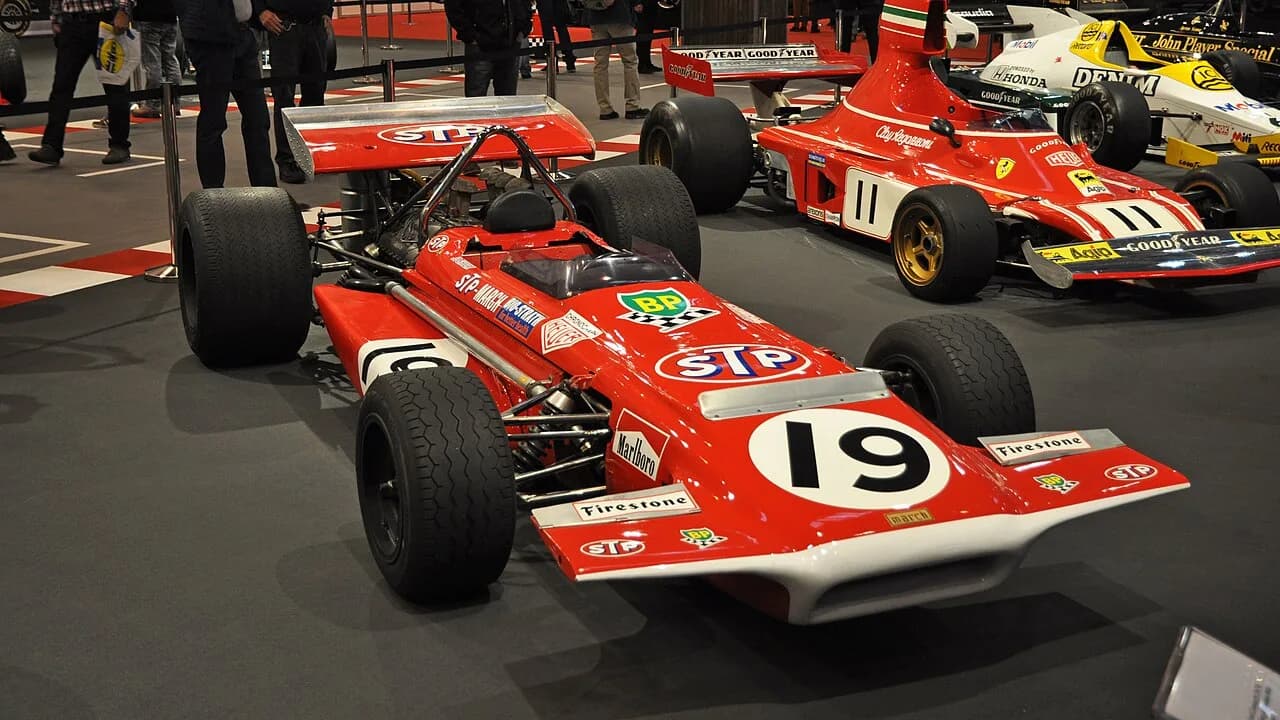
Team story
Origins
March was founded in 1969 through an agreement between Max Mosley, Alan Rees, Graham Coaker and Robin Herd. The idea encompassed a works team and the sale of single-seaters to customers. In 1970 Jackie Stewart raced Tyrrell’s 701, taking the first podium at Kyalami and the first victory at Jarama.
A customer’s success belonged to the constructor, not to the March works team.
The Formula 1 journey
Ronnie Peterson was a leading figure in the early seasons. In 1975 the 751 brought together two very different episodes: Vittorio Brambilla’s victory in the rain in Austria and Lella Lombardi’s half-point in the tragic, curtailed Spanish Grand Prix. Peterson added victory at Monza in 1976.
The programme subsequently went through withdrawals, returns and new management, without a continuous World Championship presence.
Historical timeline
Three chapters in the story of March
Three episodes to revisit the people, cars and races that shaped this journey.
First appearance · South African Grand Prix
Jackie Stewart · South African Grand Prix 1970. The recorded position is P3; this number alone does not show whether the driver completed the race distance. This is the first recorded race start, or the first entry if the team never started a race.
Sporting landmark · Spanish Grand Prix
Jackie Stewart · Spanish Grand Prix 1970. The recorded position is P1; this number alone does not show whether the driver completed the race distance. This marks the first win or podium where one exists, otherwise the highest recorded placing for this constructor.
Latest recorded appearance · Australian Grand Prix
Emanuele Naspetti · Australian Grand Prix 1992. The recorded outcome is DNF. This is the last race start attributed to this constructor in the archive, not necessarily the end of the organisation behind it.
A distinctive way of racing
The ability to supply chassis to several teams makes March difficult to reduce to a single pair of drivers. The 711, the 721 family and subsequent cars represent designs and revisions, not a count of individual examples. In the late 1980s Ivan Capelli and Maurício Gugelmin drove cars developed by Adrian Newey, supported by Leyton House’s money and colours.
What remains
In 1990 and 1991 the constructor was registered as Leyton House, before returning to the March name in 1992. The 1993 entries brought no further starts. Its legacy also encompasses junior categories and American racing: production far wider than the F1 team’s activities.
In the World Championship, it is chiefly the customers, drivers and designers who came together around its chassis that remain.