Team story
Origins
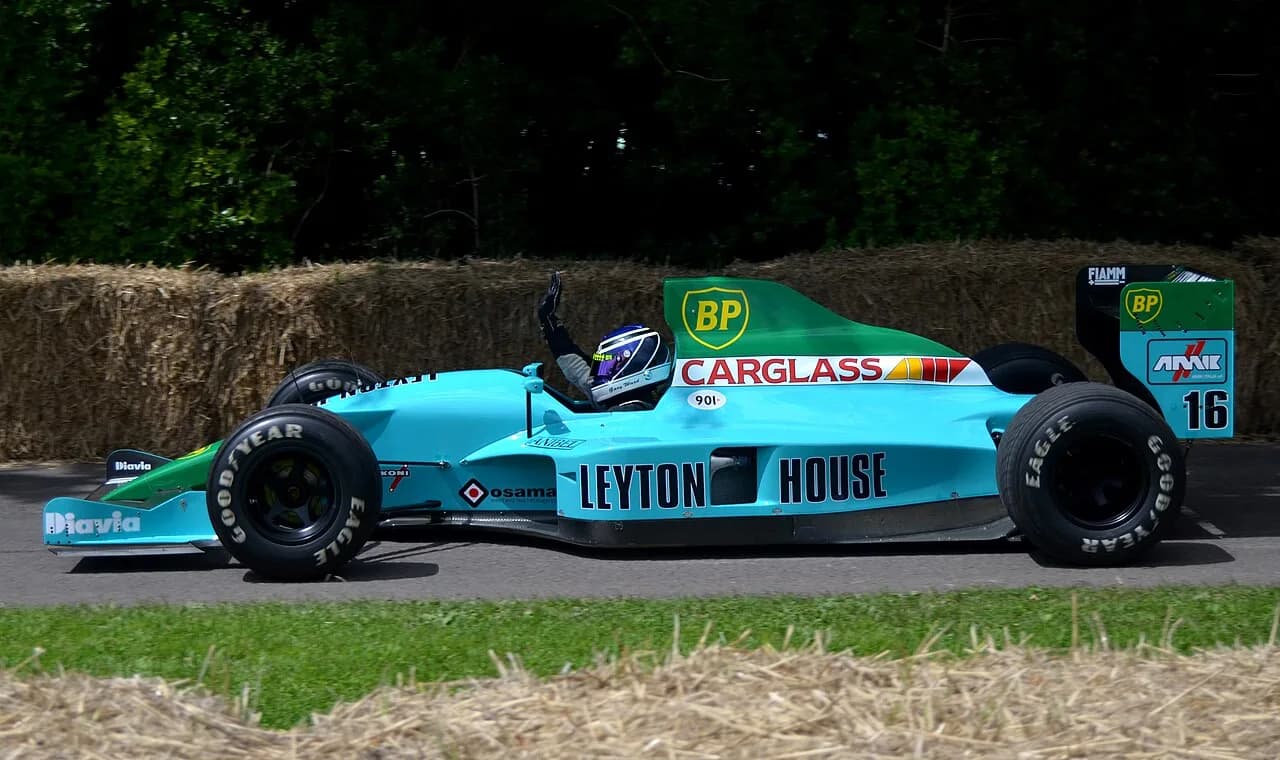
Leyton House turquoise arrived in Formula 1 before it became the constructor’s name. Akira Akagi had backed Ivan Capelli and March’s return in 1987; having acquired the programme, he entered the team as Leyton House Racing in 1990. Capelli and Maurício Gugelmin continued as drivers, while the CG901 retained Adrian Newey’s aerodynamic work.
The Formula 1 journey
Just two weeks separated failure to qualify in Mexico from second place in France. At Paul Ricard in 1990, Capelli and Gugelmin found themselves at the front thanks to the decision to avoid a tyre change. The Brazilian retired with engine trouble; Alain Prost passed Capelli towards the end.
That second place remained the only podium achieved under the Leyton House name.
Historical timeline
Three chapters in the story of Leyton House
Three episodes to revisit the people, cars and races that shaped this journey.
First appearance · United States Grand Prix
Maurício Gugelmin · United States Grand Prix 1990. The recorded position is P14; this number alone does not show whether the driver completed the race distance. This is the first recorded race start, or the first entry if the team never started a race.
Sporting landmark · French Grand Prix
Ivan Capelli · French Grand Prix 1990. The recorded position is P2; this number alone does not show whether the driver completed the race distance. This marks the first win or podium where one exists, otherwise the highest recorded placing for this constructor.
Latest recorded appearance · Australian Grand Prix
Karl Wendlinger · Australian Grand Prix 1991. The recorded position is P20; this number alone does not show whether the driver completed the race distance. This is the last race start attributed to this constructor in the archive, not necessarily the end of the organisation behind it.
A distinctive way of racing
The French strategy was not improvised during the race: Capelli recalled that Gustav Brunner had focused Friday practice on preserving the tyres. Newey’s narrow, sensitive car could perform very differently from one circuit to another. In 1991 the CG911 switched from the Judd V8 to the new Ilmor V10, without finding consistency to match that day in France.
What remains
Akagi’s legal difficulties in 1991 undermined the programme’s stability. Karl Wendlinger replaced Capelli for the final two races, and the March name returned in 1992. The initials CG commemorated Cesare Gariboldi, the manager who had supported Capelli: a personal connection that remained on the chassis through changes of ownership.
Leyton House’s legacy centres on this relationship between driver, backer and designers.