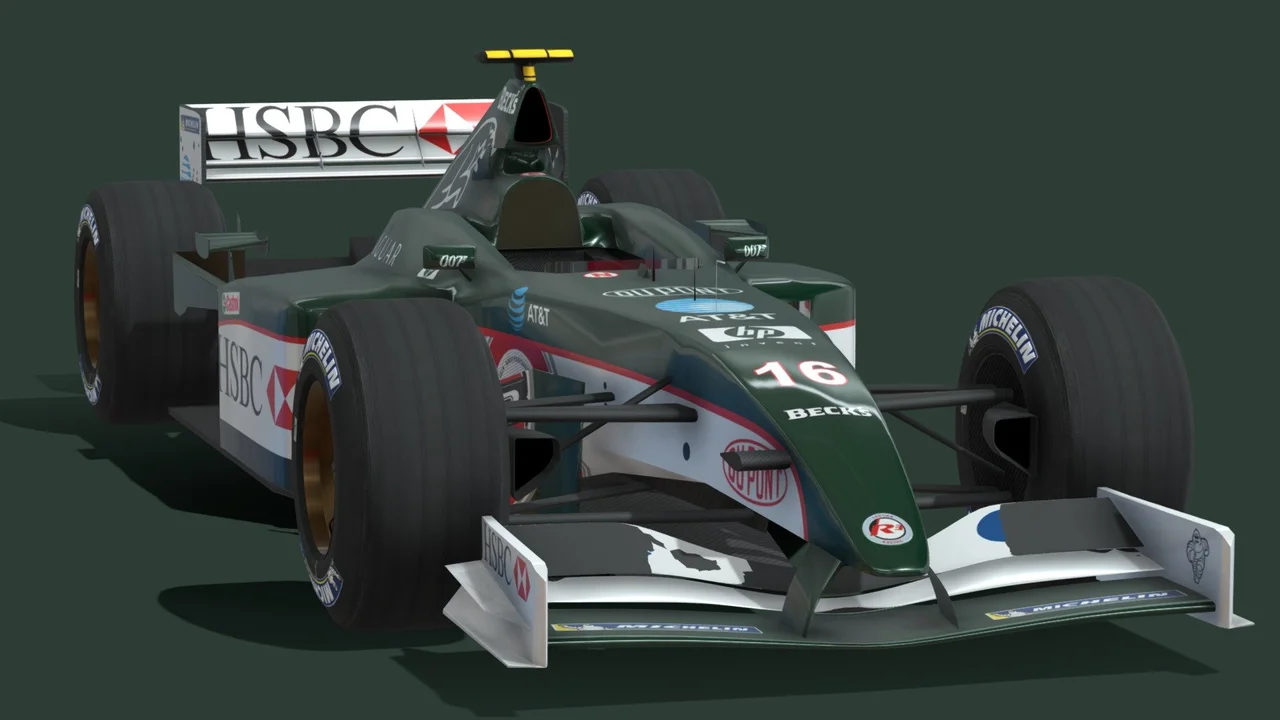
Team story
Origins
The first Formula 1 Jaguar was unveiled at Lord’s Cricket Ground in London in January 2000. The R1 grew out of Stewart-Ford, bought by Ford the previous year, retaining a British organisation in Milton Keynes. Eddie Irvine arrived from Ferrari to partner Johnny Herbert.
Its green bodywork brought a historic sports-racing marque to a single-seater powered by a Cosworth V10.
The Formula 1 journey
The project did not repeat Stewart’s victory of 1999. Irvine secured Jaguar’s two podiums: third at Monaco in 2001 and Monza in 2002. From 2003, Mark Webber became the leading driver, while the second seat passed from Antônio Pizzonia to Justin Wilson and then Christian Klien.
The R5 ended 2004 with ten points and seventh place in the constructors’ championship.
Historical timeline
Three chapters in the story of Jaguar
Three episodes to revisit the people, cars and races that shaped this journey.
First appearance · Australian Grand Prix
Eddie Irvine · Australian Grand Prix 2000. The recorded outcome is DNF. This is the first recorded race start, or the first entry if the team never started a race.
Sporting landmark · Monaco Grand Prix
Eddie Irvine · Monaco Grand Prix 2001. The recorded position is P3; this number alone does not show whether the driver completed the race distance. This marks the first win or podium where one exists, otherwise the highest recorded placing for this constructor.
Latest recorded appearance · Brazilian Grand Prix
Mark Webber · Brazilian Grand Prix 2004. The recorded outcome is DNF. This is the last race start attributed to this constructor in the archive, not necessarily the end of the organisation behind it.
A distinctive way of racing
Jaguar was the sporting face of a Ford programme, with engines supplied by Cosworth, which also belonged to the group. The R1–R5 succession charts work on an inherited organisation, rather than a transfer of its earlier Le Mans cars into Formula 1. Constructor names must also be distinguished in the results: Stewart’s victory and Red Bull’s later successes belong to other phases of the same organisation.
What remains
Ford put the team up for sale at the end of 2004, and Red Bull bought it to race from 2005. Webber joined Williams, while Klien remained with the new team. The Jaguar Daimler Heritage Trust preserves Webber’s R5 in its final-season livery: an object capturing the transition between the Jaguar venture and an organisation that would undergo profound changes of name and results.