Team story
Origins
Campos Meta secured a place in the 2010 World Championship, but reached the winter without sufficient funding. José Ramón Carabante took control of the project and Colin Kolles took charge of its management. Its name became Hispania Racing, then HRT.
The Dallara-built, Cosworth-powered F110 reached Bahrain without pre-season testing, with Bruno Senna and Karun Chandhok as drivers.
The Formula 1 journey
Its three seasons were a struggle to qualify and keep the cars running. Vitantonio Liuzzi took thirteenth place at the 2011 Canadian Grand Prix, the team’s best World Championship result. That same year, Daniel Ricciardo made his debut at Silverstone in an HRT.
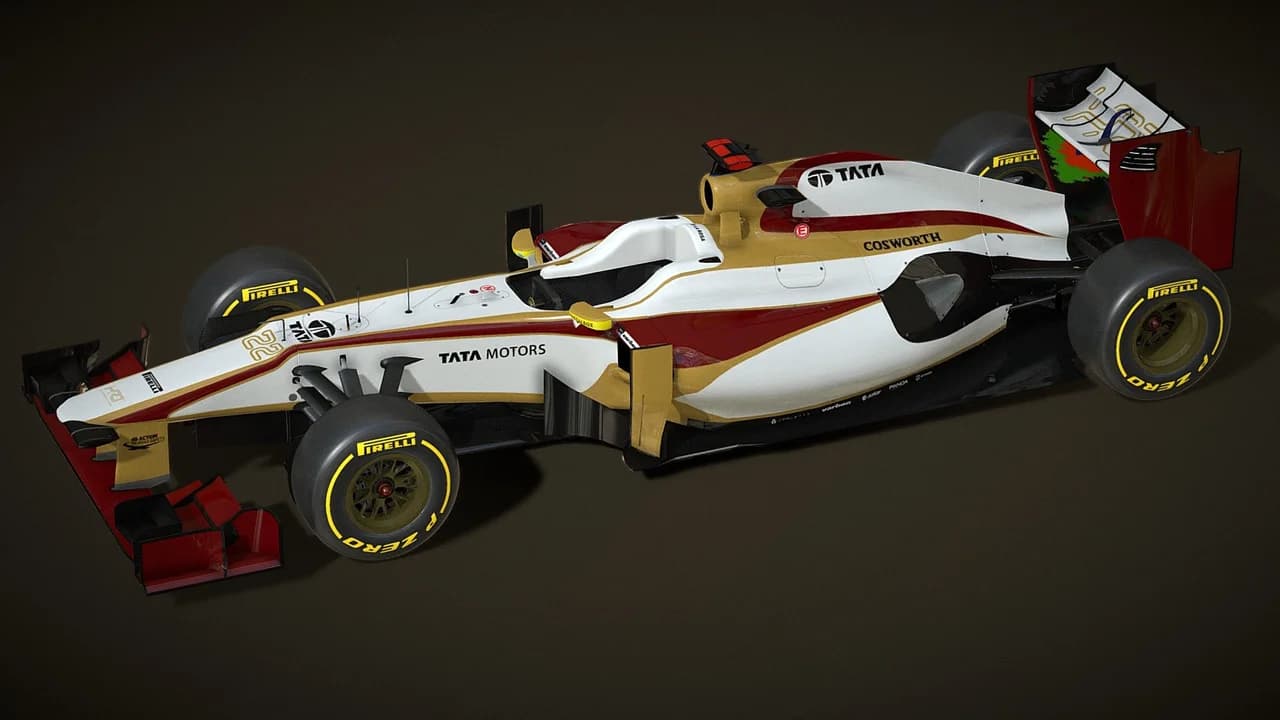
In 2012, Pedro de la Rosa and Narain Karthikeyan drove the F112; the Brazilian Grand Prix was its last race, with no points scored throughout its career.
Historical timeline
Three chapters in the story of HRT
Three episodes to revisit the people, cars and races that shaped this journey.
First appearance · Bahrain Grand Prix
Bruno Senna · Bahrain Grand Prix 2010. The recorded outcome is DNF. This is the first recorded race start, or the first entry if the team never started a race.
Sporting landmark · Canadian Grand Prix
Vitantonio Liuzzi · Canadian Grand Prix 2011. The recorded position is P13; this number alone does not show whether the driver completed the race distance. This marks the first win or podium where one exists, otherwise the highest recorded placing for this constructor.
Latest recorded appearance · Brazilian Grand Prix
Narain Karthikeyan · Brazilian Grand Prix 2012. The recorded position is P18; this number alone does not show whether the driver completed the race distance. This is the last race start attributed to this constructor in the archive, not necessarily the end of the organisation behind it.
A distinctive way of racing
HRT was Spanish but went through several ownership and organisational arrangements. Its initial collaboration with Dallara did not produce a stable development programme; the attempt to use Toyota’s abandoned project also failed. Thesan Capital and Luis Pérez-Sala brought a new direction and a move to Madrid, without those changes closing the technical gap.
What remains
The search for a buyer did not secure its continuation beyond 2012. Three models remain, the F110, F111 and F112, along with careers that passed through those seats. Ricciardo’s debut is the best-known connection with subsequent Formula 1 history; the team itself, however, was not transformed into another constructor on the same grid.