Team story
Origins
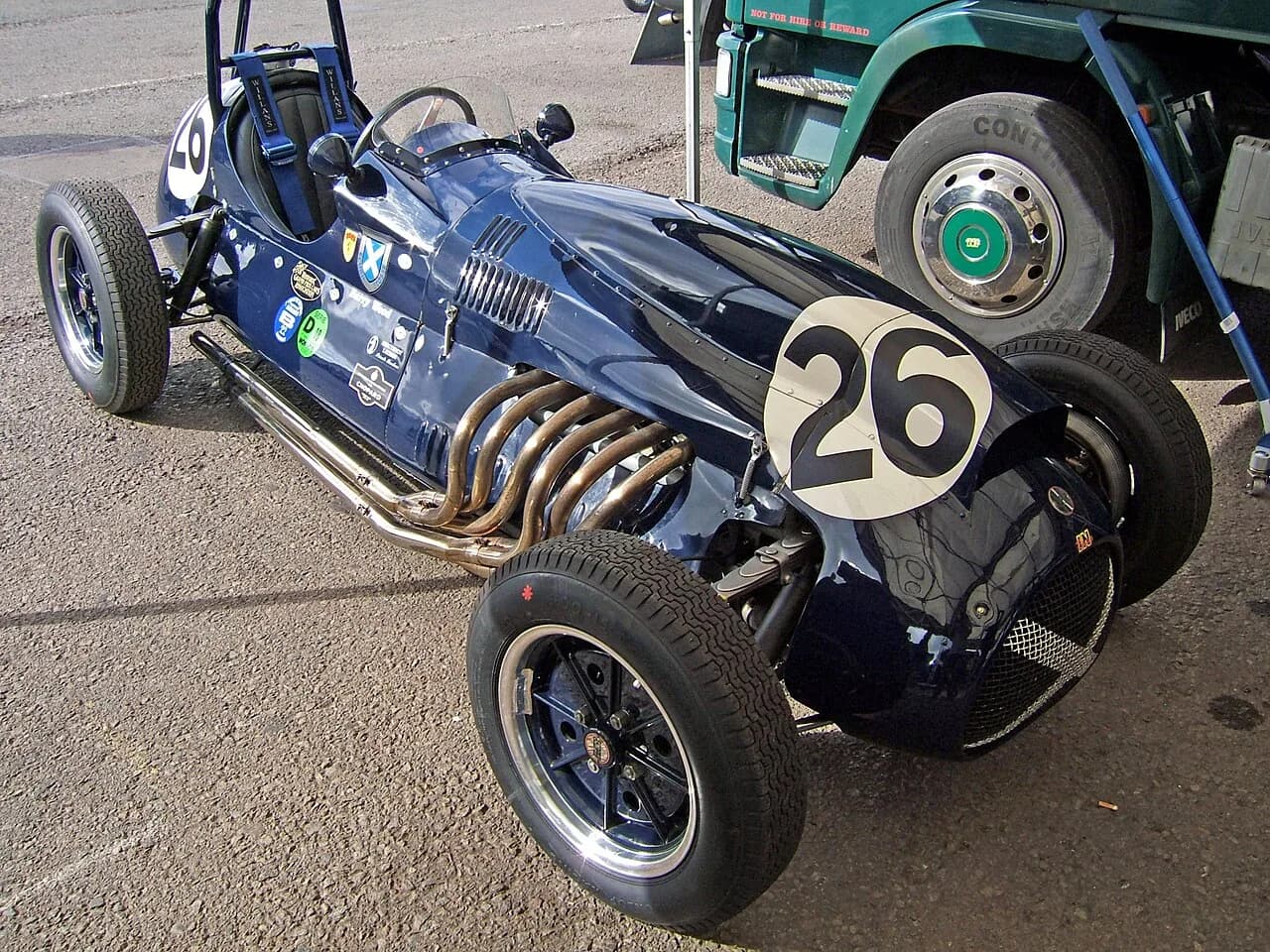
Charles Cooper and his son John began after the war by building inexpensive 500cc single-seaters in their Surbiton garage. They placed the motorcycle engine behind the driver mainly to simplify the chain transmission; that practical solution nevertheless pointed towards the future. As they gradually moved up through the categories, the Cooper-Climax cars retained their light weight, traction and ease of maintenance, eventually demonstrating in 1958 that a compact rear-engined single-seater could beat the powerful traditional cars.
The Formula 1 journey
The 1959 T51 was small, light and nimble compared with the powerful front-engined Ferraris. Jack Brabham developed it with an engineer-driver’s feel and won the World Championship; in 1960 the T53 made the advantage even clearer, giving Cooper a second consecutive Constructors’ title. In just two seasons the entire grid adopted the same architecture.
The team remained competitive with Bruce McLaren, but could not keep pace with the new monocoques and 3-litre engines, withdrawing at the end of the 1960s.
Historical timeline
Three chapters in the story of Cooper
Three episodes to revisit the people, cars and races that shaped this journey.
First appearance · Monaco Grand Prix
Harry Schell · Monaco Grand Prix 1950. The recorded outcome is DNF. This is the first recorded race start, or the first entry if the team never started a race.
Sporting landmark · Argentine Grand Prix
Stirling Moss · Argentine Grand Prix 1958. The recorded position is P1; this number alone does not show whether the driver completed the race distance. This marks the first win or podium where one exists, otherwise the highest recorded placing for this constructor.
Latest recorded appearance · Monaco Grand Prix
Vic Elford · Monaco Grand Prix 1969. The recorded position is P7; this number alone does not show whether the driver completed the race distance. This is the last race start attributed to this constructor in the archive, not necessarily the end of the organisation behind it.
A distinctive way of racing
Cooper designed out of necessity before theory. Its cars had to be inexpensive, repairable and suitable for private customers too; the rear-engined layout emerged from this practical environment rather than a revolutionary manifesto. Brabham then helped turn a good idea into a competitive system, working on set-up, reliability and making the most of the light Coventry Climax.
The simplicity that made the revolution possible became a limitation when Lotus introduced the monocoque and structural integration. Cooper remains the clearest example of how a small workshop can change the paradigm through consistently applied common sense.
What remains
Cooper did not invent the rear-engined layout outright, but demonstrated in Formula 1 that it was more effective and turned it into the definitive standard. It was a revolution born of efficiency: a solution developed for small, affordable single-seaters made decades of tradition obsolete. The team was also a school for Brabham and McLaren, who would establish constructors bearing their own names.
Its legacy therefore lives on in the architecture of every modern single-seater and in the technical dynasties it helped to create.