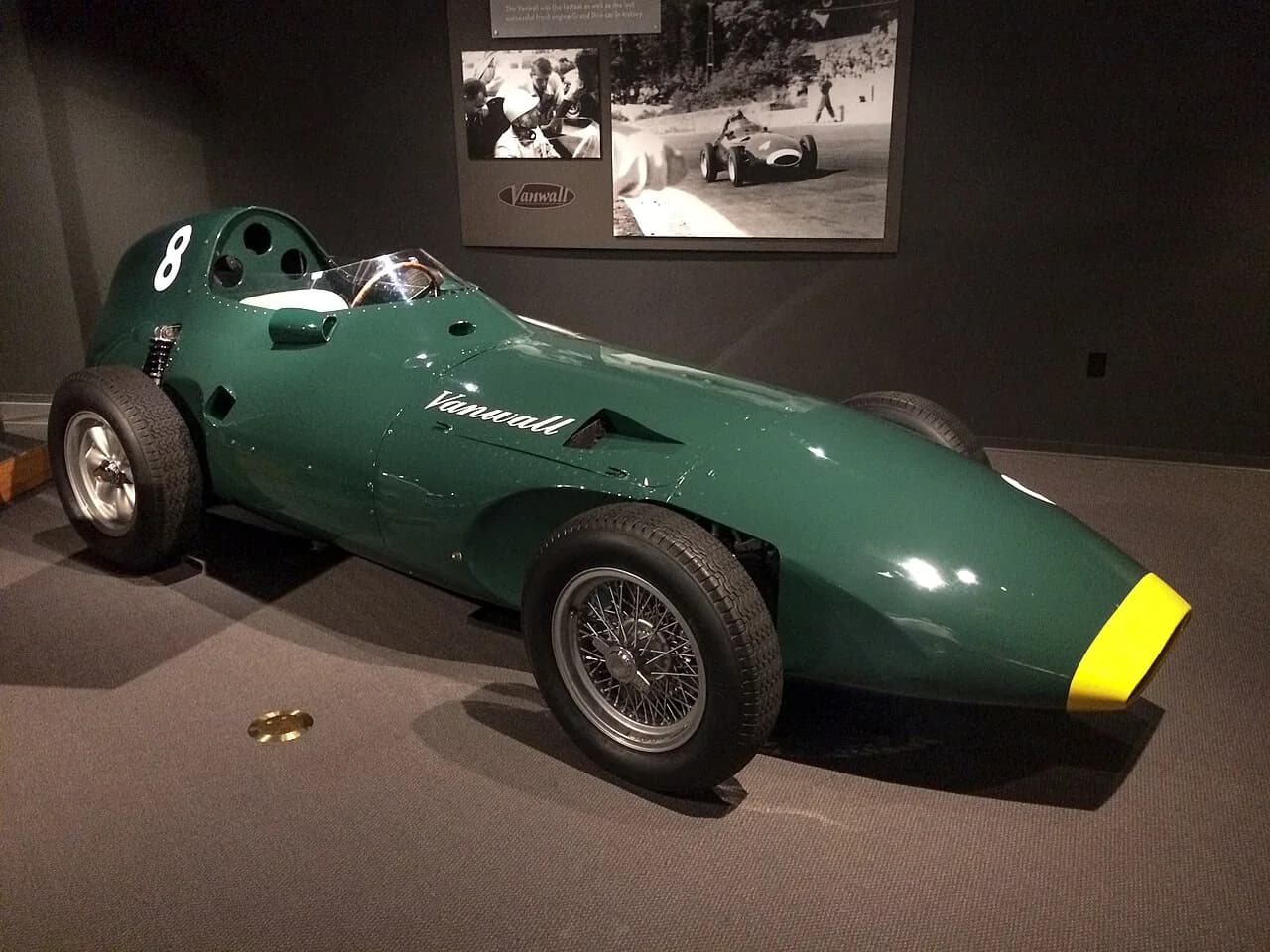
Team story
Origins
Tony Vandervell, a bearing manufacturer and early BRM supporter, decided to create an independent team starting from his own Thinwall Specials. The Vanwall name combined Vandervell and Thinwall. To build a genuine challenger he brought together exceptional talents: Colin Chapman worked on the chassis, Frank Costin designed very clean aerodynamic bodywork, and Harry Weslake contributed to the fuel-injected four-cylinder engine.
By 1956 the car had the speed needed to take on Ferrari and Maserati.
The Formula 1 journey
Stirling Moss and Tony Brooks shared Vanwall’s first World Championship victory at Aintree in 1957; that year Moss also won at Pescara and Monza. In 1958 the team fielded Moss, Brooks and Stuart Lewis-Evans: it won six of the eleven counting races and secured the first Constructors’ World Championship ever awarded. The Drivers’ title instead went to Ferrari’s Mike Hawthorn by a single point.
Lewis-Evans’s death and Vandervell’s health problems led to the withdrawal of the full-time programme immediately after the triumph.
Historical timeline
Three chapters in the story of Vanwall
Three episodes to revisit the people, cars and races that shaped this journey.
First appearance · British Grand Prix
Peter Collins · British Grand Prix 1954. The recorded outcome is DNF. This is the first recorded race start, or the first entry if the team never started a race.
Sporting landmark · British Grand Prix
Tony Brooks · British Grand Prix 1957. The recorded position is P1; this number alone does not show whether the driver completed the race distance. This marks the first win or podium where one exists, otherwise the highest recorded placing for this constructor.
Latest recorded appearance · French Grand Prix
Tony Brooks · French Grand Prix 1960. The recorded outcome is DNF. This is the last race start attributed to this constructor in the archive, not necessarily the end of the organisation behind it.
A distinctive way of racing
Vanwall was built as a network of specialists before this model became common in British motorsport. Vandervell provided funding and demanded results; Chapman stiffened and lightened the chassis; Costin reduced the bodywork’s drag; Weslake worked on the engine’s breathing. There was no major car manufacturer behind it, but a guiding hand capable of combining expertise from different sectors.
Disc brakes, fuel injection and attention to aerodynamics produced a car suited to fast circuits. The success of 1958 demonstrated that coordinated specialisation could overcome the continental constructors’ integrated approach.
What remains
Vanwall was short-lived, but it changed Formula 1’s geography. The first constructors’ trophy went to a British team just as the country’s workshops were preparing the technical revolution of the 1960s. The project showed the value of coordinating independent expertise around a common goal and offered Chapman and Costin a crucial stage.
It did not build a dynasty, and that is precisely what makes 1958 unrepeatable: having reached the top, the team disappeared almost completely from the scene.