Team story
Origins
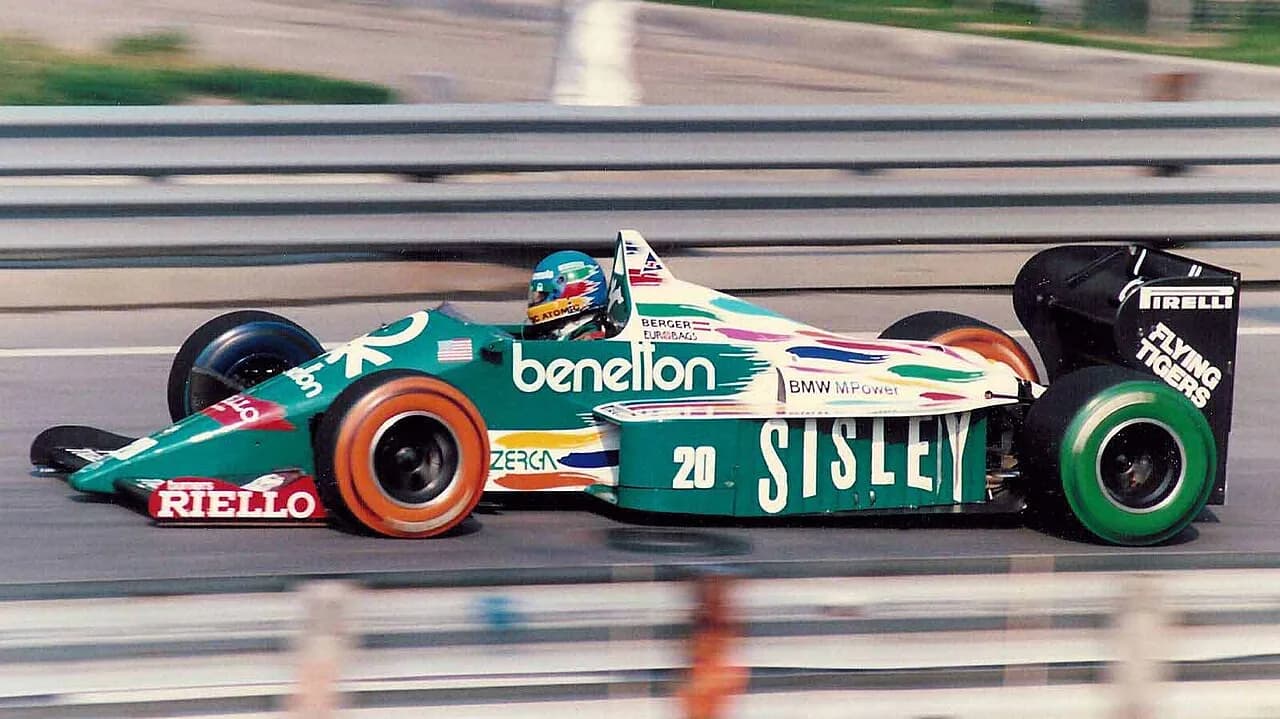
Benetton entered Formula 1 as a sponsor and in 1985 bought Toleman, the team with which Ayrton Senna had made his name. From 1986, the Italian group’s name appeared on the cars, but the technical base remained in England: first at Witney, then at Enstone from 1992. Gerhard Berger won in Mexico in its debut season.
Colours, provocative advertising campaigns and a cosmopolitan image set the team apart, while it was building a racing organisation far more serious than its unconventional appearance suggested.
The Formula 1 journey
Flavio Briatore’s arrival changed the scale of the project. Michael Schumacher became its sporting focus, while Ross Brawn, Rory Byrne and a close-knit technical team developed agile, efficient cars. The 1994 drivers’ title came in an intensely tense and controversial championship; in 1995, with Renault power, Benetton also won the constructors’ championship and Schumacher retained his crown.
His departure for Ferrari began a period of gradual decline, ending with Renault’s acquisition in 2000.
Historical timeline
Three chapters in the story of Benetton
Three episodes to revisit the people, cars and races that shaped this journey.
First appearance · Brazilian Grand Prix
Gerhard Berger · Brazilian Grand Prix 1986. The recorded position is P6; this number alone does not show whether the driver completed the race distance. This is the first recorded race start, or the first entry if the team never started a race.
Sporting landmark · Mexican Grand Prix
Gerhard Berger · Mexican Grand Prix 1986. The recorded position is P1; this number alone does not show whether the driver completed the race distance. This marks the first win or podium where one exists, otherwise the highest recorded placing for this constructor.
Latest recorded appearance · Japanese Grand Prix
Giancarlo Fisichella · Japanese Grand Prix 2001. The recorded position is P17; this number alone does not show whether the driver completed the race distance. This is the last race start attributed to this constructor in the archive, not necessarily the end of the organisation behind it.
A distinctive way of racing
Benetton brought its brand’s ability to communicate through colour, provocation and global recognition to Formula 1, but behind the image it built a highly focused technical organisation. Enstone worked with swift decision-making and developed cars that prioritised agility, electronic integration and adaptation to its leading driver. Briatore did not come from engineering and organised the team by selecting complementary specialists; Brawn translated racing into method, Byrne into design solutions, and Schumacher into development and performance.
That model would be transferred almost in its entirety to Ferrari’s subsequent revival.
What remains
Benetton was much more than a commercial interlude. It introduced a new visual language to the paddock and showed that a brand outside the automotive industry could build genuine expertise, rather than merely buy exposure. Above all, it brought together people who would shape subsequent eras: the Brawn-Byrne-Schumacher core moved to Ferrari, while Enstone became the home of Renault’s 2005 and 2006 titles.
Its constructors’ championship remains a one-off, but its organisational legacy has multiplied elsewhere.