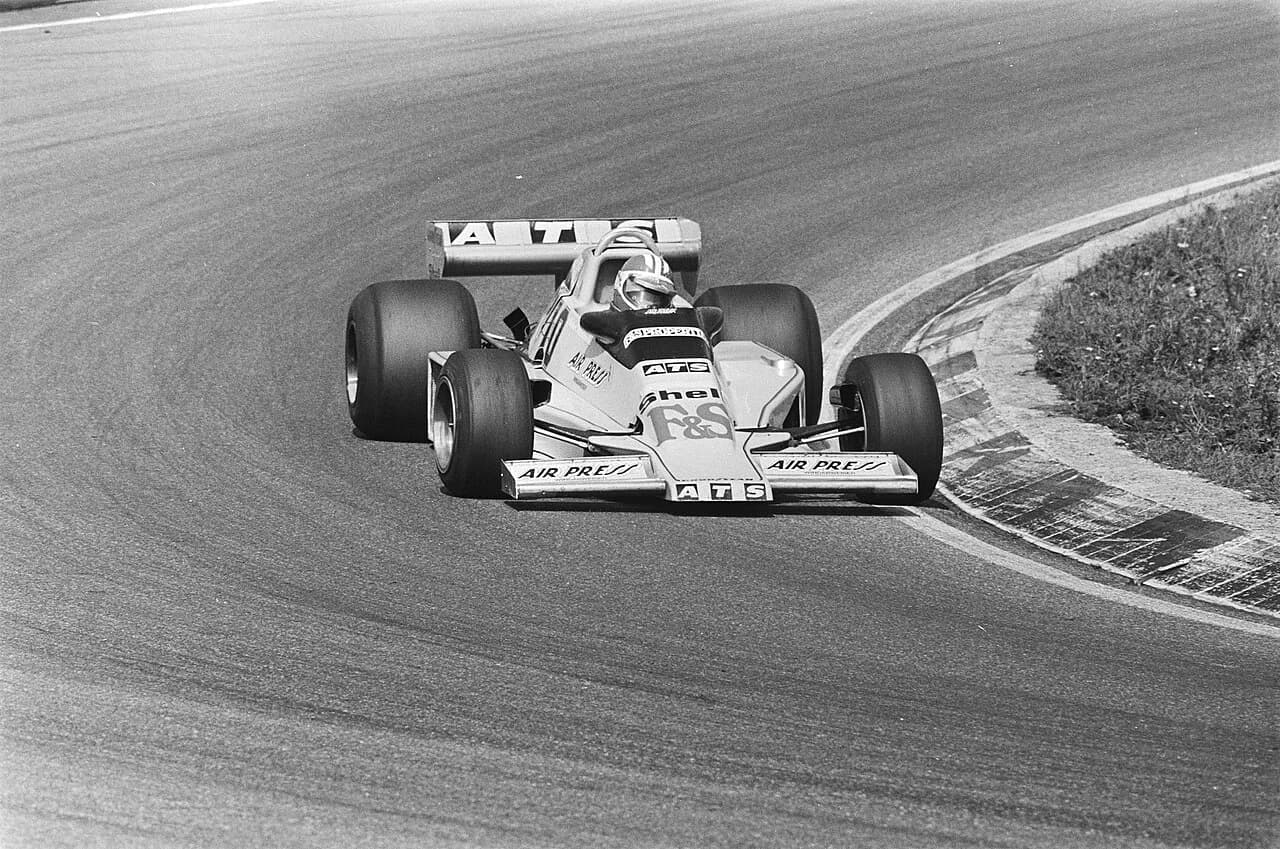
Team story
Origins
Alloy wheels were the starting point for Günter Schmid's ATS, a Bad Dürkheim company named Auto Technisches Spezialzubehör. To promote it, Schmid entered Formula 1 in 1977 by buying Penske cars. The move to constructor status came in 1978 with the HS1: this is where the career of ATS chassis recorded in the archive begins.
The Formula 1 journey
Hans-Joachim Stuck took the D3 to fifth at Watkins Glen in 1979. In 1980, Jan Lammers earned an impressive fourth place on the grid at Long Beach but retired. Manfred Winkelhock was the mainstay of the turbo seasons; Gerhard Berger made his debut with the D7 in 1984.
The team never took a podium and ended its World Championship activity at the close of that year.
Historical timeline
Three chapters in the story of ATS
Three episodes to revisit the people, cars and races that shaped this journey.
First appearance · Argentine Grand Prix
Jochen Mass · Argentine Grand Prix 1978. The recorded position is P11; this number alone does not show whether the driver completed the race distance. This is the first recorded race start, or the first entry if the team never started a race.
Sporting landmark · United States Grand Prix
Hans-Joachim Stuck · United States Grand Prix 1979. The recorded position is P5; this number alone does not show whether the driver completed the race distance. This marks the first win or podium where one exists, otherwise the highest recorded placing for this constructor.
Latest recorded appearance · Portuguese Grand Prix
Gerhard Berger · Portuguese Grand Prix 1984. The recorded position is P13; this number alone does not show whether the driver completed the race distance. This is the last race start attributed to this constructor in the archive, not necessarily the end of the organisation behind it.
A distinctive way of racing
Gustav Brunner designed the D6 around a carbon-fibre monocoque and BMW's four-cylinder turbo engine, replacing the naturally aspirated Cosworth. Technical development did not eliminate mechanical fragility. Frequent changes of designer and driver accompanied a programme dependent on Schmid's decisions, with qualifying performances that often failed to become race results.
What remains
The ATS industrial name outlived the team. Schmid would return to the World Championship with Rial, another wheel brand and another sporting identity. Jarier's point at Long Beach in 1977 also belonged to a Penske chassis, not the HS1.
Nothing, meanwhile, connects this ATS with the Automobili Turismo e Sport of Phil Hill and Baghetti in 1963.