Team story
Origins
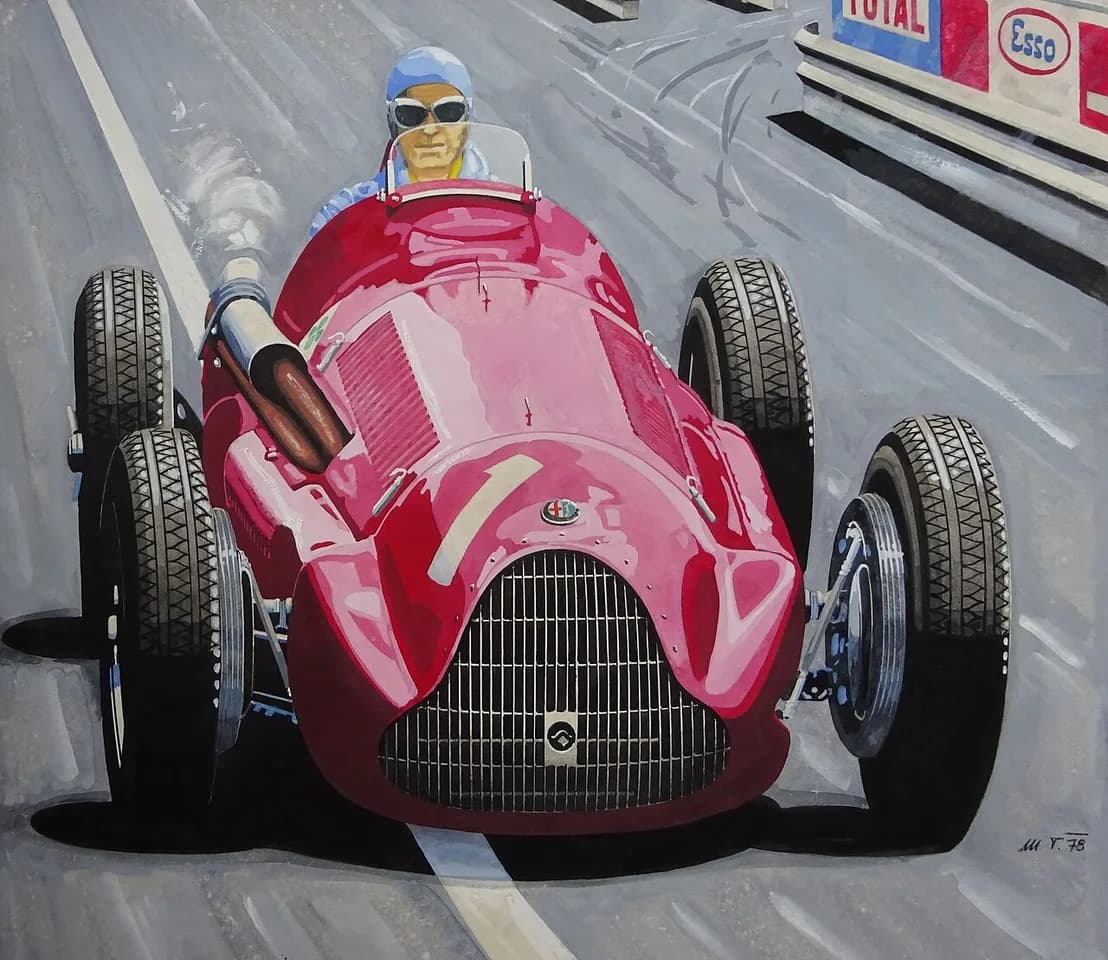
The Alfetta 158 was not created for the 1950 championship: its design dated back to the 1930s. Yet it was in that supercharged single-seater that Nino Farina won the first World Championship race at Silverstone and the first Drivers' title. Juan Manuel Fangio secured the next title in 1951 with the 159, a development of the same technical family.
The Formula 1 journey
The return as a constructor came in 1979 with Bruno Giacomelli and the 177, followed by the 179. Giacomelli's pole at Watkins Glen in 1980 and Andrea de Cesaris's at Long Beach in 1982 showed speed that did not translate into victories. In 1983, the 183T introduced turbocharging; the final campaign of this period was in 1985.
Historical timeline
Three chapters in the story of Alfa Romeo
Three episodes to revisit the people, cars and races that shaped this journey.
First appearance · British Grand Prix
Nino Farina · British Grand Prix 1950. The recorded position is P1; this number alone does not show whether the driver completed the race distance. This is the first recorded race start, or the first entry if the team never started a race.
Sporting landmark · British Grand Prix
Nino Farina · British Grand Prix 1950. The recorded position is P1; this number alone does not show whether the driver completed the race distance. This marks the first win or podium where one exists, otherwise the highest recorded placing for this constructor.
Latest recorded appearance · Abu Dhabi Grand Prix
Valtteri Bottas · Abu Dhabi Grand Prix 2023. The recorded position is P19; this number alone does not show whether the driver completed the race distance. This is the last race start attributed to this constructor in the archive, not necessarily the end of the organisation behind it.
A distinctive way of racing
Three eras carry the same badge, but not the same organisation. The works Alfettas were followed by the Autodelta programme; from 2019 to 2023, it was instead Sauber that built the cars in Hinwil, with Ferrari power units and an Alfa Romeo commercial partnership. Kimi Räikkönen and Antonio Giovinazzi opened this period, followed by Valtteri Bottas and Zhou Guanyu.
What remains
Farina and Fangio gave Alfa Romeo two Drivers' titles, not two Constructors' Championships: that trophy would not be introduced until 1958. The modern partnership also retained Sauber's naming convention, from the C38 to the C43. The badge therefore connects cars and people from very different periods, while their technical programmes and sporting responsibilities remain distinct.