Team story
Origins
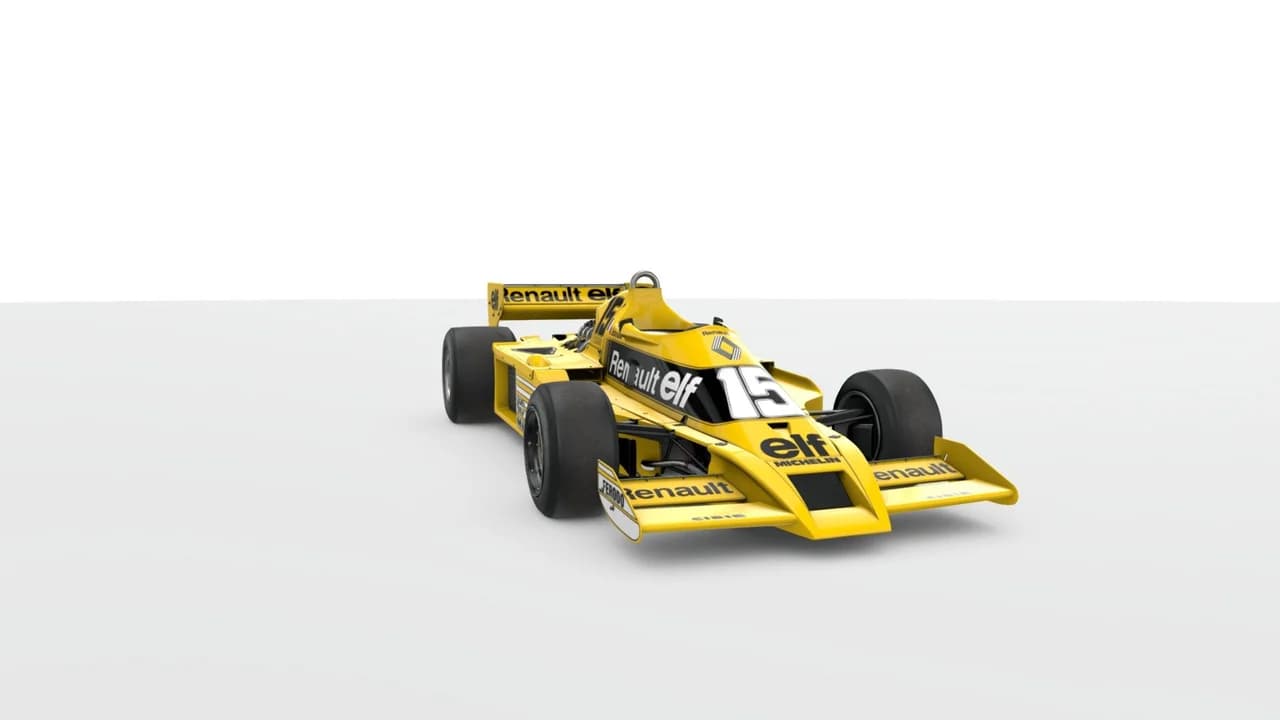
Renault entered as a constructor in 1977 with the RS01, choosing a small turbocharged V6 while the grid still relied on naturally aspirated three-litre engines. Frequent early failures drew ridicule, but Jean-Pierre Jabouille's first victory at Dijon in 1979 demonstrated that forced induction was the future. The works programme ended after 1985, while the engine operation continued and became crucial to Williams and Benetton's titles in the 1990s.
The Formula 1 journey
Renault bought Benetton in 2000 and renamed it in 2002, inheriting the Enstone factory and building an extremely efficient project around Flavio Briatore, Pat Symonds and Fernando Alonso. The R25 of 2005 ended the Ferrari-Schumacher run; the R26 retained both titles in 2006, beating Ferrari through the final stages of the season. The marque subsequently alternated between withdrawal, supplying engines and returning as a works team: its V8s also powered Red Bull's four championships, while Enstone would eventually become Alpine.
Historical timeline
Three chapters in the story of Renault
Three episodes to revisit the people, cars and races that shaped this journey.
First appearance · British Grand Prix
Jean-Pierre Jabouille · British Grand Prix 1977. The recorded outcome is DNF. This is the first recorded race start, or the first entry if the team never started a race.
Sporting landmark · French Grand Prix
Jean-Pierre Jabouille · French Grand Prix 1979. The recorded position is P1; this number alone does not show whether the driver completed the race distance. This marks the first win or podium where one exists, otherwise the highest recorded placing for this constructor.
Latest recorded appearance · Abu Dhabi Grand Prix
Esteban Ocon · Abu Dhabi Grand Prix 2020. The recorded position is P9; this number alone does not show whether the driver completed the race distance. This is the last race start attributed to this constructor in the archive, not necessarily the end of the organisation behind it.
A distinctive way of racing
Renault's most consistent characteristic has been a willingness to pursue unconventional technical paths. The turbo required years of failures before becoming inevitable; in the early 2000s the very wide-angle engine and then more conservative solutions showed the same desire to find an architectural advantage. Enstone, meanwhile, developed a practical culture capable of achieving a great deal with fewer resources than its main rivals.
The union of the British factory and French engine operation has produced extraordinary results, but repeated changes of ownership and objectives have often interrupted its continuity.
What remains
Renault's influence needs to be considered on two levels. As a constructor it won two championships with an agile team that made the most of strategy, reliability and its driver's talent; as an engine supplier it twice changed the technical balance, first establishing the turbo and then powering other teams' dynasties. Its history is not linear and passes through different identities, but this very technical continuity under different names and roles shows how deeply French industry has shaped Formula 1's evolution.