Team story
Origins
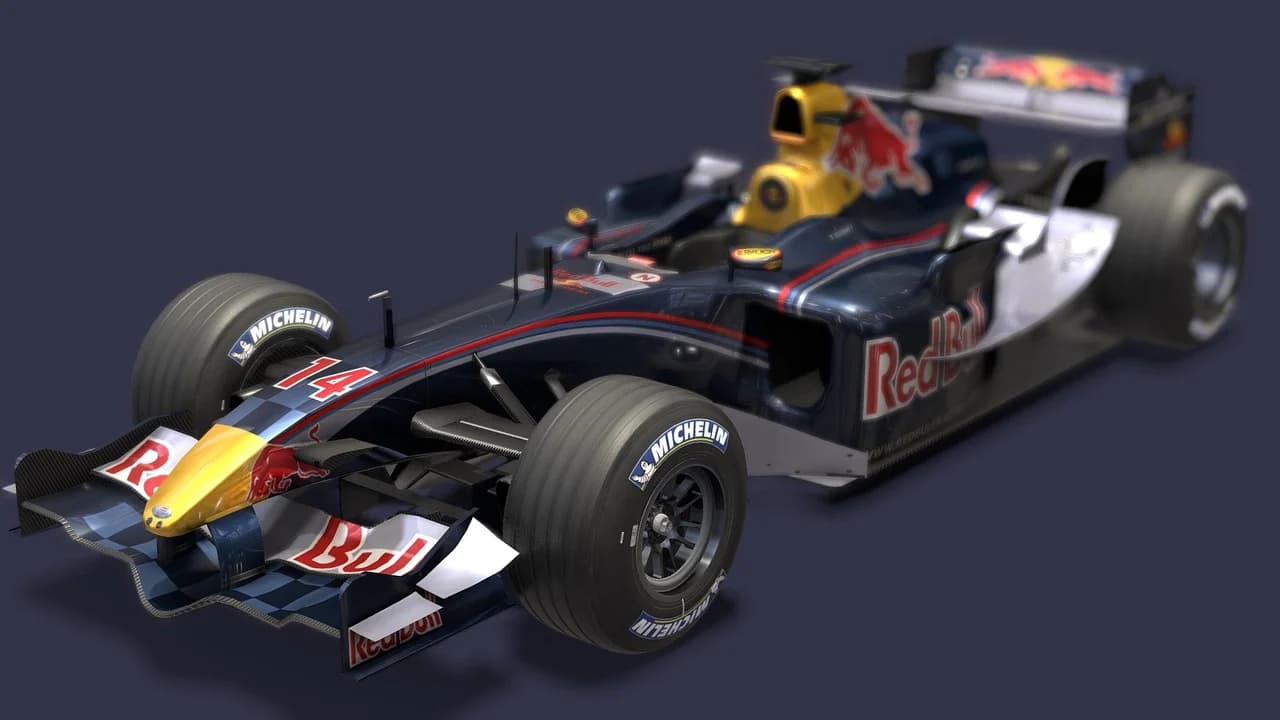
Red Bull Racing was created in 2005 through the acquisition of Jaguar, itself the successor to Stewart Grand Prix. Dietrich Mateschitz did more than use Formula 1 as a shop window: he entrusted a young organisation in Milton Keynes to Christian Horner and, in 2006, persuaded Adrian Newey to lead its technical direction. The early seasons transformed a midfield team into a fully fledged constructor, supported by a talent pipeline linked to Toro Rosso and an identity more aggressive than that of the major car manufacturers.
The Formula 1 journey
Vettel's victory in China in 2009 heralded the first great cycle: from 2010 to 2013, Red Bull secured four consecutive doubles of Drivers' and Constructors' titles with Renault-powered cars featuring extreme aerodynamics. The hybrid era ended its dominance, not its competitiveness. The Honda partnership and Max Verstappen's rise reopened the pursuit of the Drivers' title in 2021; the RB18 and RB19 then brought the team the Constructors' titles in 2022 and 2023, with the latter turning the season into one of the clearest demonstrations of superiority in history.
Historical timeline
Three chapters in the story of Red Bull
Three episodes to revisit the people, cars and races that shaped this journey.
First appearance · Australian Grand Prix
David Coulthard · Australian Grand Prix 2005. The recorded position is P4; this number alone does not show whether the driver completed the race distance. This is the first recorded race start, or the first entry if the team never started a race.
Sporting landmark · Chinese Grand Prix
Sebastian Vettel · Chinese Grand Prix 2009. The recorded position is P1; this number alone does not show whether the driver completed the race distance. This marks the first win or podium where one exists, otherwise the highest recorded placing for this constructor.
Latest recorded appearance · Spanish Grand Prix
Liam Lawson · Spanish Grand Prix 2026. The recorded position is P6; this number alone does not show whether the driver completed the race distance. This is the latest start in the archived snapshot, not the end of the team’s activities.
A distinctive way of racing
In 2005, the Red Bull name replaced Jaguar, but the cars continued to be built in Milton Keynes. Newey's arrival changed the technical direction; Vettel's gave the project a driver capable of converting speed into titles. Toro Rosso, meanwhile, offered another way to assess young drivers in races.
Both Vettel and Verstappen passed through that organisation before becoming the leading figures of the senior team. This tangible succession of people, factories and seats explains the Red Bull model better than the image of a team that was simply younger or more aggressive than the others.
What remains
The first victory in China and the twenty-one races won in 2023 mark two ends of a journey that was not always an upward climb. Between Vettel's titles and Verstappen's were seasons in which the move to hybrid engines had shifted the advantage towards Mercedes. The Honda connection and new cars made it possible to return to the front.
Red Bull is therefore a story of two winning cycles, not uninterrupted superiority: driver, engine and regulations change, while the name that replaced Jaguar in 2005 becomes one of the leading names in the championship's roll of honour.