Team story
Origins
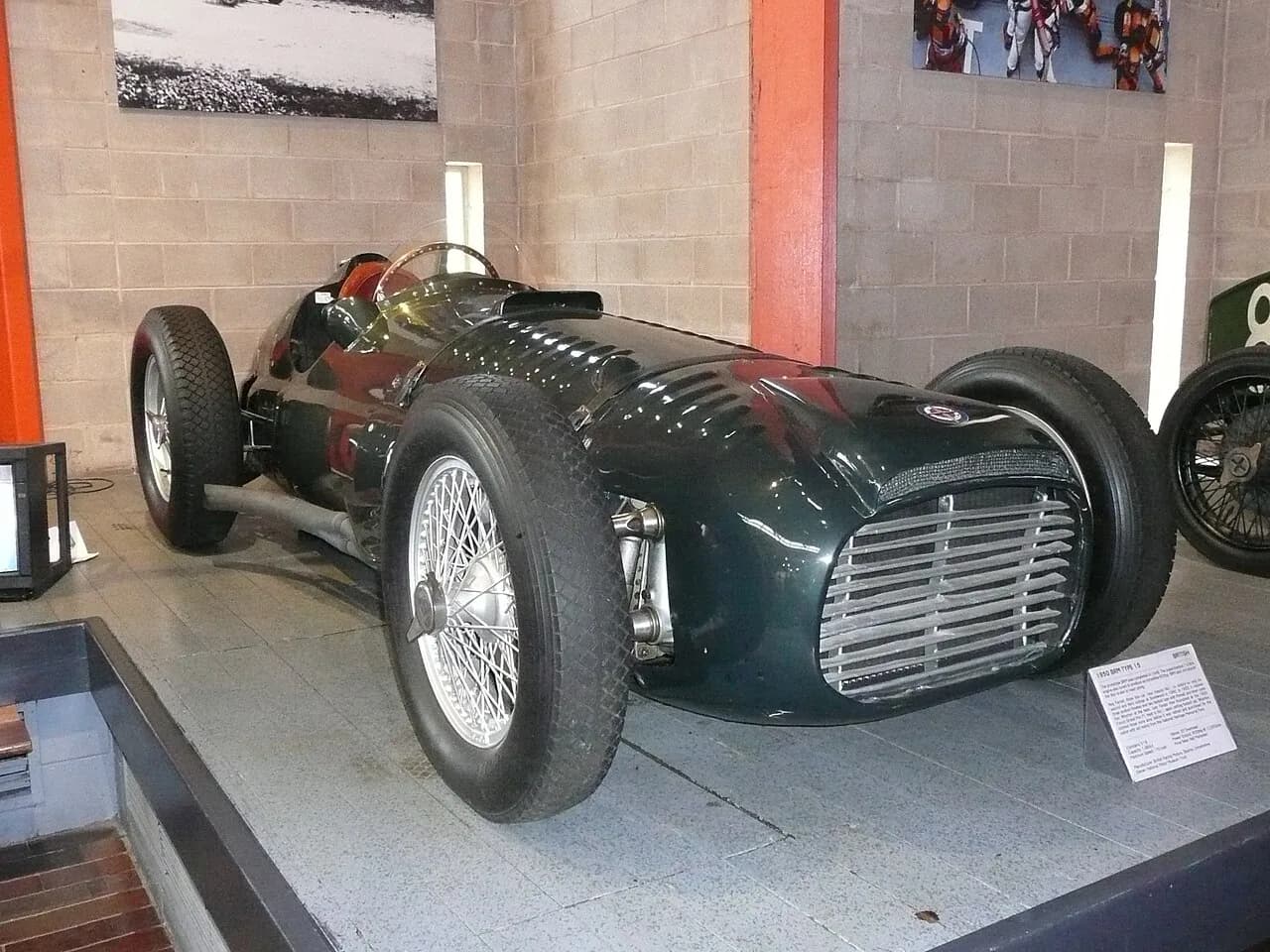
British Racing Motors was established in 1945 around Raymond Mays and Peter Berthon as a national response to continental dominance. Dozens of British companies supported the project, which immediately chose the most complex route: the Type 15 with its supercharged V16 promised exceptional power but suffered from delays, fragility and enormous expectations. Only after Alfred Owen’s industrial group became involved and that initial ambition was abandoned did BRM find technical and organisational stability.
The Formula 1 journey
Jo Bonnier secured the P25’s first victory in 1959. In 1962 the compact P57, designed by Tony Rudd and powered by BRM’s V8, was reliable and consistent: Graham Hill won four Grands Prix, the Drivers’ Championship and the Constructors’ Championship. With Hill and then Jackie Stewart, the team remained at the front until the middle of the decade.
The subsequent H16 engine proved too heavy and complex; isolated victories by Pedro Rodríguez and Peter Gethin did not halt the financial and technical decline that ended in 1977.
Historical timeline
Three chapters in the story of BRM
Three episodes to revisit the people, cars and races that shaped this journey.
First appearance · British Grand Prix
Reg Parnell · British Grand Prix 1951. The recorded position is P5; this number alone does not show whether the driver completed the race distance. This is the first recorded race start, or the first entry if the team never started a race.
Sporting landmark · Dutch Grand Prix
Jo Bonnier · Dutch Grand Prix 1959. The recorded position is P1; this number alone does not show whether the driver completed the race distance. This marks the first win or podium where one exists, otherwise the highest recorded placing for this constructor.
Latest recorded appearance · South African Grand Prix
Larry Perkins · South African Grand Prix 1977. The recorded position is P15; this number alone does not show whether the driver completed the race distance. This is the last race start attributed to this constructor in the archive, not necessarily the end of the organisation behind it.
A distinctive way of racing
BRM wanted to demonstrate that British industry could make every part of a winning single-seater at home. Funding spread across many companies made rare expertise available, but multiplied expectations and the number of stakeholders. The team truly worked when Alfred Owen provided stability and Tony Rudd reduced complexity, focusing the design on weight, reliability and ease of maintenance.
The later H16 instead repeated the V16’s original flaw: a solution that was fascinating on paper, but too heavy and difficult to develop on the track. BRM’s biography is therefore also a lesson in the relationship between ambition and control of a project.
What remains
BRM embodies the pride and contradictions of post-war British engineering. The V16’s failure showed how a spectacular design could be stifled by fragmentation, while the 1962 title came through choosing simplicity and clear responsibilities. It was one of the few constructors of the period to produce both chassis and engine, developed engineers and drivers who would leave their mark on the championship, and demonstrated that Britain could also win with a complete industrial project.