Team story
Origins
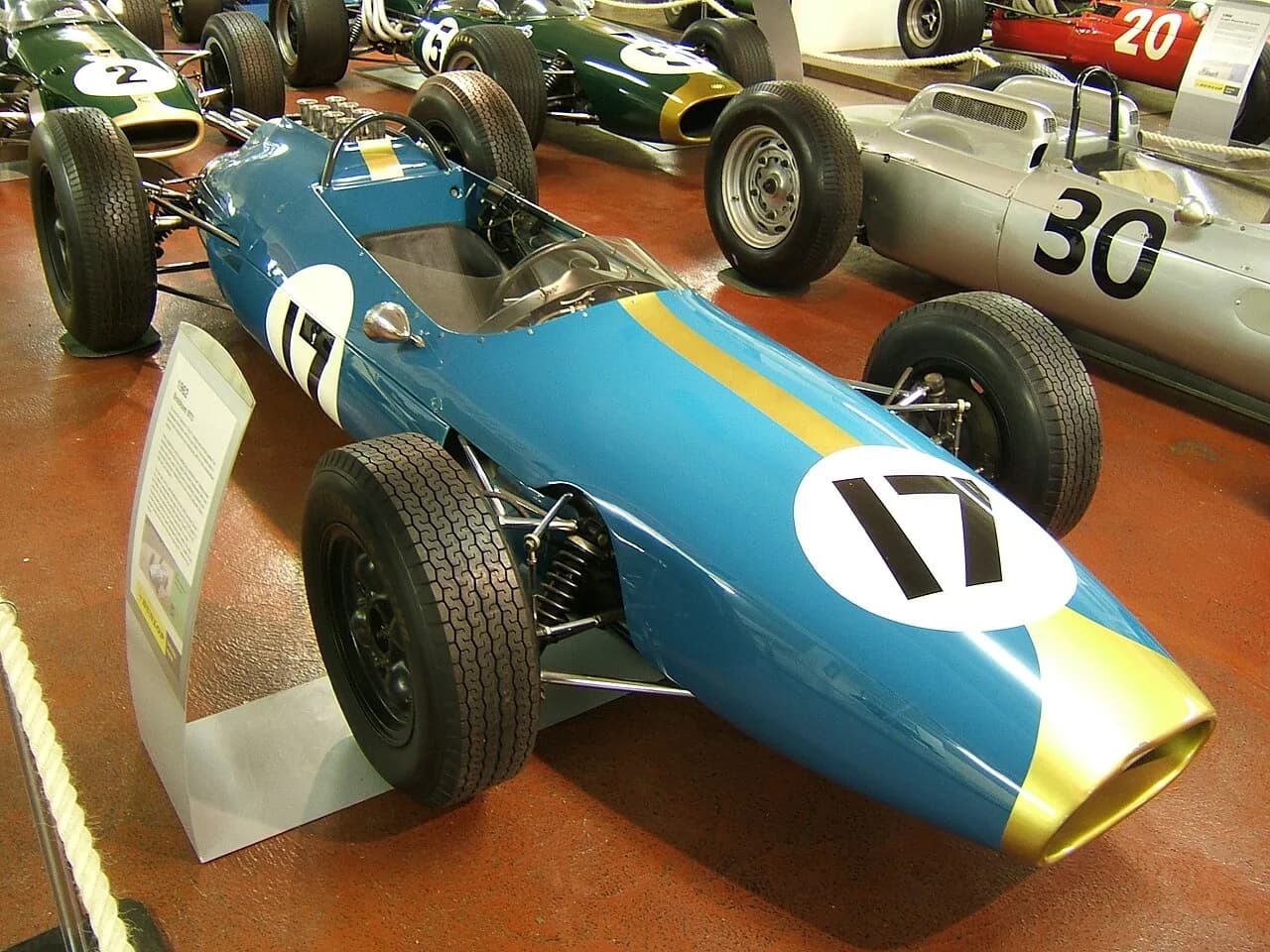
Jack Brabham and Ron Tauranac founded Motor Racing Developments in 1961 to build robust single-seaters that were simple to set up and could be sold to customers in junior formulae. The MRD name was soon replaced by Brabham, more recognisable outside England. The team made its Formula 1 debut in 1962 and grew pragmatically.
When the regulations changed to three litres in 1966, it chose a Repco V8 derived from a production engine: less powerful than its rivals, but light and reliable.
The Formula 1 journey
Jack Brabham won in 1966, becoming the only driver to be champion in a car bearing his own name; Denny Hulme and the team retained the titles in 1967. After Bernie Ecclestone bought the team, Gordon Murray turned Brabham into a laboratory: the fan-equipped BT46B raced and won just once in 1978, while the compact cars of the 1980s took Nelson Piquet to the 1981 and 1983 titles. The latter was the first Drivers’ World Championship of the turbo era, won with BMW’s four-cylinder engine.
Historical timeline
Three chapters in the story of Brabham
Three episodes to revisit the people, cars and races that shaped this journey.
First appearance · German Grand Prix
Jack Brabham · German Grand Prix 1962. The recorded outcome is DNF. This is the first recorded race start, or the first entry if the team never started a race.
Sporting landmark · French Grand Prix
Dan Gurney · French Grand Prix 1964. The recorded position is P1; this number alone does not show whether the driver completed the race distance. This marks the first win or podium where one exists, otherwise the highest recorded placing for this constructor.
Latest recorded appearance · Hungarian Grand Prix
Damon Hill · Hungarian Grand Prix 1992. The recorded position is P11; this number alone does not show whether the driver completed the race distance. This is the last race start attributed to this constructor in the archive, not necessarily the end of the organisation behind it.
A distinctive way of racing
The first Brabham prioritised robustness, accessibility and ease of adjustment, qualities born of Tauranac’s experience in customer categories and Jack’s mechanical feel. With Ecclestone and Murray, the same practicality became extreme experimentation: radiating surfaces, ground effect, a fan, refuelling and single-seaters designed around a minimal frontal area. Murray sought integrated, coherent solutions rather than adding complexity without purpose.
This ability to change character while retaining a pragmatic outlook connects the title earned with the simple Repco to the one won by taming the brutal power of the BMW turbo.
What remains
Brabham spans three stories: the driver-constructor of the 1960s, Ecclestone and Murray’s spectacular team, and finally the decline that ended in 1992. Its innovations were ingenious responses to resources and regulations: straightforward engines, unconventional aerodynamics, strategic refuelling and exceptionally low chassis. The team also produced figures crucial to Formula 1’s commercial and technical development, making its influence much wider than the two Constructors’ titles in the record books.